The Manchester region experienced numerous Luftwaffe bombing attacks during WW2. Beginning with air raids in June 1940 they continued through the horrific Manchester Blitz in December with raids continuing until March 1945. Nearby Stockport didn’t escape the war unscathed. Bombed several times, it was once again under attack 85 years ago today in the early hours of Thursday 8th May 1941. That night a massive air raid was underway across the northwest of England. Over 340 Luftwaffe bombers attacked targets around Manchester and Liverpool. Air Raid sirens were sounded in Manchester and Stockport at 23:40 on that Wednesday evening.
Involved in operations that night were Heinkel He 111P-4 bombers from Kampfgeschwader 55 (KG 55, Battle Wing 55) who are perhaps the best known of all WW2 German bomber squadrons. One of the aircraft with the code G1+LH had taken off from the airfield at Melun-Villaroche near Paris with its crew of four. The Pilot was Oberleutnant Adolf Knorringer, the Bomb Aimer Oberfeldwebel Karl Kohlhopp, and the Flight Engineer was Oberfeldwebel Alois Klos. The fourth member of the crew was Wireless Operator/Air Gunner Unteroffizer Ludwig Rathsam – it was his 21st birthday.
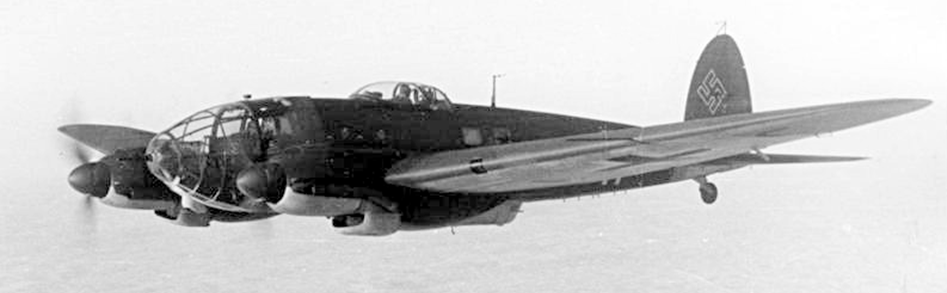
Flying at over 18,000 feet they followed the signals from sophisticated radio beams directing them to their primary target of Liverpool. As they came from the east high over the Pennines, they would no doubt have seen the search lights, exploding anti-aircraft shells, and fires raging from the bombardment that was already well underway. Boulton Paul Defiant two seat night fighter aircraft of 256 Sqn were scrambled from RAF Squires Gate airfield (now Blackpool Airport) at 28 minutes past midnight followed at ten to one by more Defiants of 96 Sqn from RAF Cranage in Cheshire. It wasn’t long before the first German losses were incurred. Heinkel G1-LL was shot down near Bagillt in the Dee Estuary with the loss of three of its aircrew.
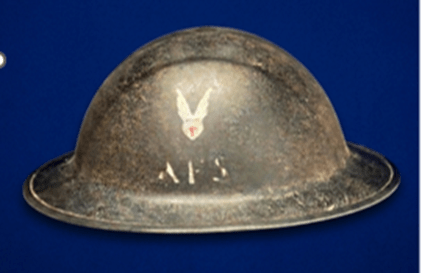
G1+LH may have dropped its high explosive bombs somewhere over Liverpool but it’s believed the fierce air defences and the activity of the night fighters prompted Oberleutnant Knorringer to proceed to his secondary target to the south of Manchester where Fairey Aviation were making Fulmar aircraft for the Fleet Air Arm and Beaufighters for the Bristol Aircraft Company. At around about 01:15, flying from east to west, the aircraft released its entire load of deadly incendiary bombs designed to start fires. Many smashed through the roof of a single storey building at Fairey’s damaging racking with aircraft components and others set alight the roof of the foreman’s office. Fairey’s own onsite Auxiliary Fire Service (AFS) volunteers were immediately at the scene and quickly put out the fires and removed any un-exploded incendiary bombs.
Adjacent to Fairey’s was McVitie’s biscuit factory which was also hit and sustained even more damage than Fairey’s. A huge blaze destroyed an entire building before the fires were eventually brought under control. Fortunately, there were no casualties.
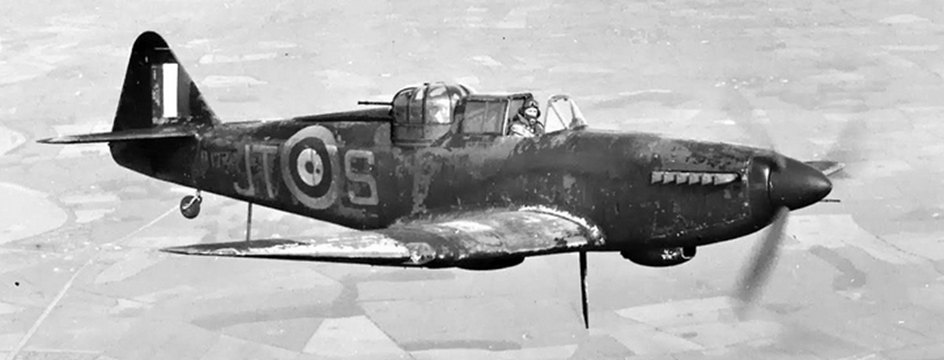
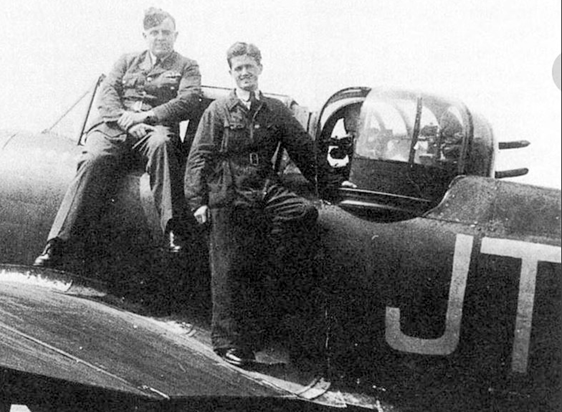
256 Sqn Defiant N1745 coded JT-P which had taken off from RAF Squires Gate was detailed to patrol around Liverpool at 14,000 feet which should have been above the exploding flak shells. Piloted by Flt Lt Deanesly who was conscious of the Anti-Aircraft Artillery shells exploding above their target height which indicated to him that there was enemy aircraft activity nearby.
Frustrated at having lost contact with an enemy aircraft earlier he had strayed east over south Manchester when just after 01:15 Sgt Scott, Deanesly’s air gunner noticed the unmistakeable shape of a Heinkel approaching from their rear. Defiants were curious aircraft, looking a bit like a Hawker Hurricane but with a turret and four .303 Browning machine guns behind the pilot’s seat. This cumbersome configuration meant that there was no forward or downward firing positions.
Deanesly immediately brought his Defiant aircraft round in a steep turn to position his aircraft just below and to the right of the Heinkel where Scott fired over 10 rounds into the side of the Heinkel which took immediate evasive action diving steeply towards the ground, the pilot Knorringer hoping to outrun his attacker. Deanesly immediately followed with his engine racing at full power and flying at over 300mph the Defiant was positioned below and to the right of the Heinkel at about 50 yards where Scott unleashed almost 800 rounds from his four machine guns. Both the Heinkel’s engines burst into flames. Knorringer had no other option, he brought his aircraft to a level flight and called for the crew to bale out.
Deanesly followed the Heinkel as it turned into a fireball, pitched up gaining over 500 feet before arcing towards the ground lighting up the night sky like a meteorite. At about 8000 feet Deanesly concerned about tethered barrage ballons and convinced of their victory pulled away and set course for home where he landed at 01:56.
Visible from all around Stockport the burning aircraft continued uncontrollably over Heaton Moor, Heaviley and Offerton and despite the time early in the morning it was witnessed by many civilian observers in addition to the ARP Wardens (Air Raid Precautions) and Fire Watchers on duty that night. The Heinkel crashed into the ground with a huge explosion near Springfield Farm adjacent to Torkington Golf Club at 01:20.
All four of the German aircrew had managed to exit the stricken Heinkel and deploy their parachutes. Knorringer landed among the houses of Cheadle where he was apprehended by a local solicitor and taken to the local police station. Kolhopp landed on the roof of a house in Bramhall from where he was detained by the Home Guard and taken to the police. Klos landed on playing fields in Hazel Grove adjacent to the industrial giants Mirlees, Bickerton, and Day factory. Allegedly, he had stayed nearby in digs as an exchange student before the war and casually walked over, knocked on the door of his previous home still in his flying gear and parachute harness where he was greeted by his former landlady with “What are you doing here?”.
Probably the last to escape the aircraft was birthday boy Rathsam. He came to ground not far from the fiercely burning wreckage of his aeroplane. Solicitor Herbert Walls had watched the events unfold together with a friend and two ARP Wardens from his garden in Hazel Grove. As soon as the aircraft exploded, they raced to the scene where they were the first to arrive. Without concern for their own safety from the burning and potentially explosive wreckage or possibly aggressive crewman they scoured the area where they found Ludwig Rathsam with wounds to his hands and face crouched by a nearby hedge minus one of his boots. Handing over his revolver, he was taken (in contravention of the procedures for Prisoners Of War) in the back of a car to Herbert Walls’ house. Here he was given a cup of tea, had his head wound dressed by Mrs Walls, who was trained First Aider and was generally made to feel at ease, though he was anxious about his parents and girlfriend back home in Germany.
Outside though it was known there was a fourth member of the German aircrew who couldn’t be accounted for which raised concerns that they make wreak even more damage. For over 40 minutes the authorities conducted a frantic search until Rathsam was handed over to the local police and taken away for interrogation.
The all-clear siren was sounded at 04:15. Although the wreckage was cordoned off and protected by police it continued to burn for some time. From daylight there was a steady flow of sightseers many of whom tried to get a memento of the German aircraft. Several tried and failed but 14-year-old Peter Broome burnt his fingers getting a Heinkel manufactures nameplate.
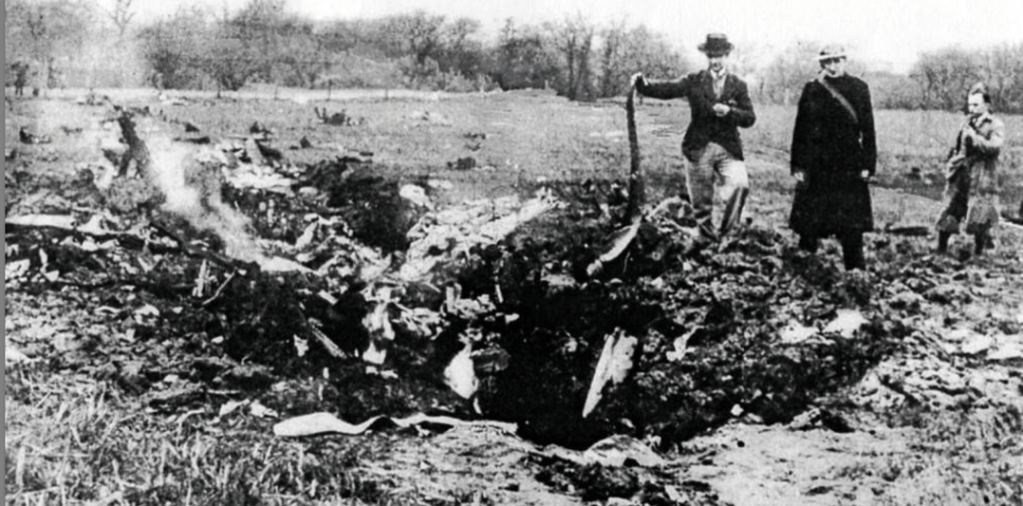
erbert Walls was severely admonished for the act of taking the German Airman home, but after the war became a prominent Stockport solicitor and Liberal Councillor on the Hazel Grove and Bramhall Urban District Council.
The four German airmen were questioned at local Police stations before transferring to Stockport County Football Stadium for further interrogation. They were then transferred to POW camps in the UK and in December 1941 were sent to POW camps in Canada where they spent the rest of the war. It is believed that members of this aircrew attempted an escape from their camp, but all four returned to Germany and in 1972 Karl Kohlhopp had made enquires to local aviation experts about the fate of his aircraft.
The Defiant aircrew both survived WW2 and went on to be decorated for their bravery. Edward Christoper ‘Jumbo’ Deanesly was awarded a DFC (Distinguished Flying Cross) and ended WW2 as a Wing Commander. He settled in Birmingham and died at the age of 88 in 1998. His Air Gunner was Seargent Willim Jack Scott was awarded a DFM (Distinguished Flying Medal). He returned home to New Zealand and died in 1999.
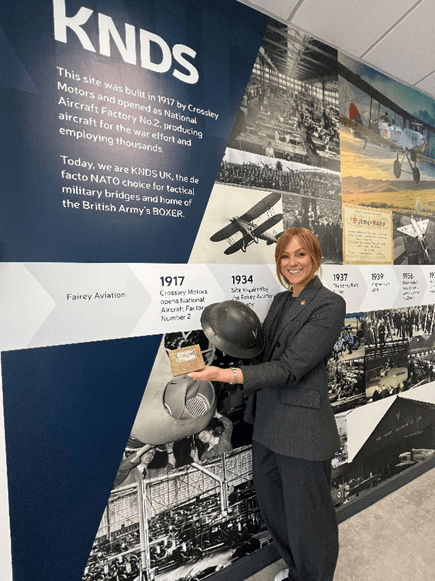
The damage to Fairey Aviation was minimal and soon repaired. The factory continued to be used to manufacture aeroplanes until the 1960’s at which time it became Fairey Engineering, then Williams Fairey Engineering who are now part of the multinational KNDS group making military bridges and Boxer armoured vehicles and are proud of their historic aviation heritage.
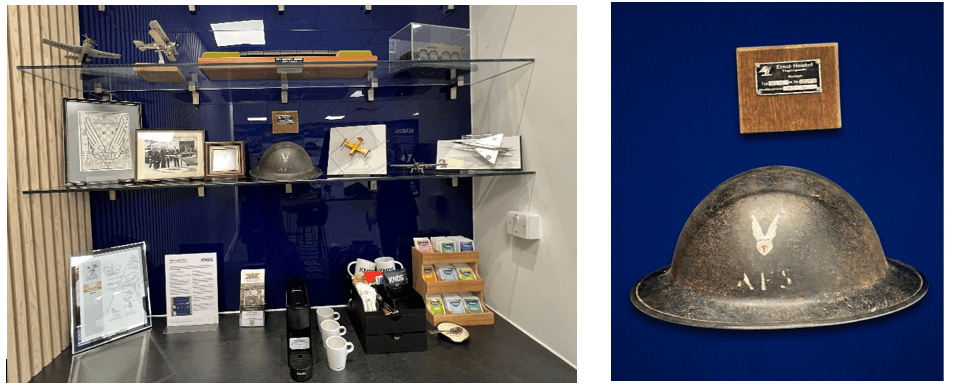
Heinkel He 111 G1+LH was the first and only enemy aircraft shot down over Manchester during WW2 so it’s appropriate that KNDS have in their history display exhibition in their foyer an AFS helmet with the Fairey logo that was quite probably worn at the time the fires were being brought under control and also the manufactures name plate from He 111 G1+LH.
Head of Communications & Marketing KNDS
References used and thanks to:
Luftwaffe over Manchester – Peter J C Smith, 2003
Eyes of the Night : Air Defence of North-Western England – Joe Bamford& Ron Collier, 2006
The Manchester Heinkel – Matthew Corrigan, 2013
The Brian Robinson Archive – Torkington He 111 folder – courtesy of Lloyd Robinson
Fairey AFS helmet – donated by Joe Jervis
He 111 manufacturers plate – donated by the relatives of Peter Broome
Les Whitehouse – The Boulton Paul Association


What a fabulous post! Thank you.
LikeLike